
The Invisible Gap: Why Your "Standard" Dust Mask Might Be Failing Your Team
In the world of industrial safety, there is a common misconception that handing out a box of FFP3 masks is enough to tick the "Respiratory Protection" box. However, if you haven't conducted a Face Fit Test, you might as well be handing out paper napkins.
At Colbrook, we see businesses across the UK investing heavily in high-quality Respiratory Protective Equipment (RPE), only to be let down by a poor seal. Here is why Face Fit Testing is the most critical step in your safety protocol.
It’s Not Just Best Practice—It’s the Law
Under the Health and Safety Executive (HSE) guidance INDG479, any employer providing tight-fitting respirators must ensure that the equipment is "suitable" for the wearer. Because every face is unique in shape and size, a mask that fits one person perfectly may leave dangerous gaps for another.
If a mask doesn't seal to the face, contaminated air will always take the path of least resistance. This means your team could be inhaling silica dust, fumes, or biological agents through the gaps, completely bypassing the filter.
The "Clean-Shaven" Rule: No Exceptions
One of the biggest hurdles in Face Fit Testing is facial hair. To achieve a legal pass, the wearer must be clean-shaven in the area where the mask meets the skin. Even 24-hour stubble is enough to lift the mask off the face and break the seal.
For staff with beards for religious or personal reasons, standard disposable masks are usually not suitable. In these cases, you must look at "loose-fitting" alternatives like powered air-fed hoods, which do not require a tight seal.
Qualitative vs. Quantitative: Which Do You Need?
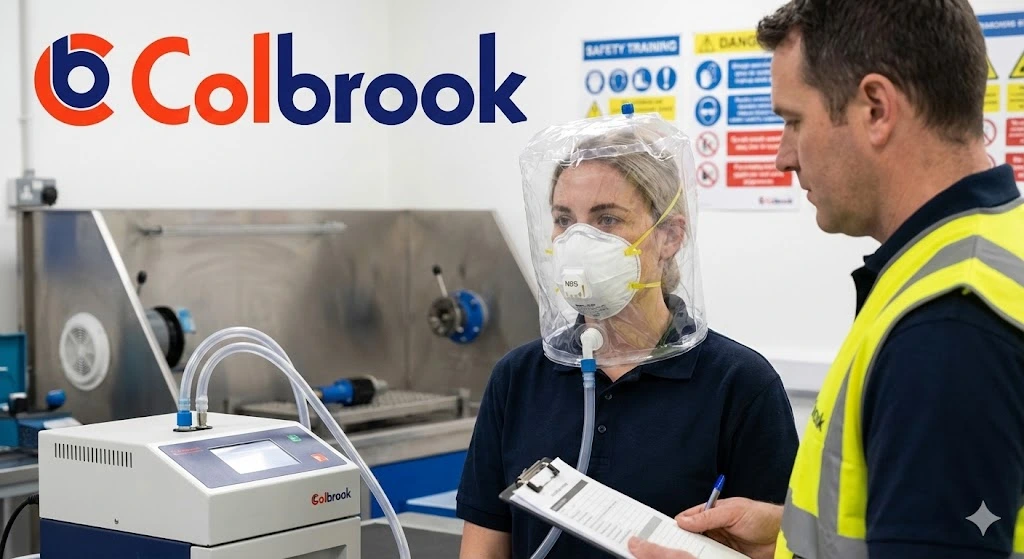
For the disposable masks (FFP1, FFP2, FFP3) and half-masks commonly used in construction and manufacturing, a Qualitative Test is the standard. This involves a sensitivity test using a bitter or sweet aerosol while the wearer performs a series of exercises—moving the head, talking, and deep breathing—to ensure the seal holds under real-work conditions.
Beyond the Test: The Daily Fit Check
A Face Fit Test is a formal assessment that should be repeated every two years (or sooner if the wearer’s face shape changes due to weight loss or dental work). However, it doesn't replace the Daily Fit Check.
Every single time a worker puts on their mask, they should perform a simple suction check to ensure they’ve donned it correctly. A certificate on the wall is only as good as the mask on the face today.
Protecting Your People and Your Business
Investing in professional Face Fit Testing does more than just satisfy an inspector. It protects your most valuable asset—your people—from long-term respiratory illnesses that can take years to manifest.
Are you compliant? If you’re unsure about your current RPE setup or need to schedule testing for your team, get in touch with the Colbrook team today. We provide the literature, the testing, and the certification to keep your site safe and legal.